


Learning Lateral T's in Horton Technique Modern Dance
The Learning Lateral T's in Horton Technique Modern Dance journey begins with understanding one of the technique's most recognizable movements. Created by Lester Horton, the Lateral T develops strength, flexibility, balance, and full-body coordination while encouraging dancers to move with precision and control.
Whether you're new to contemporary dance or building a stronger technical foundation, mastering the Lateral T will improve your posture, body awareness, and overall movement quality.
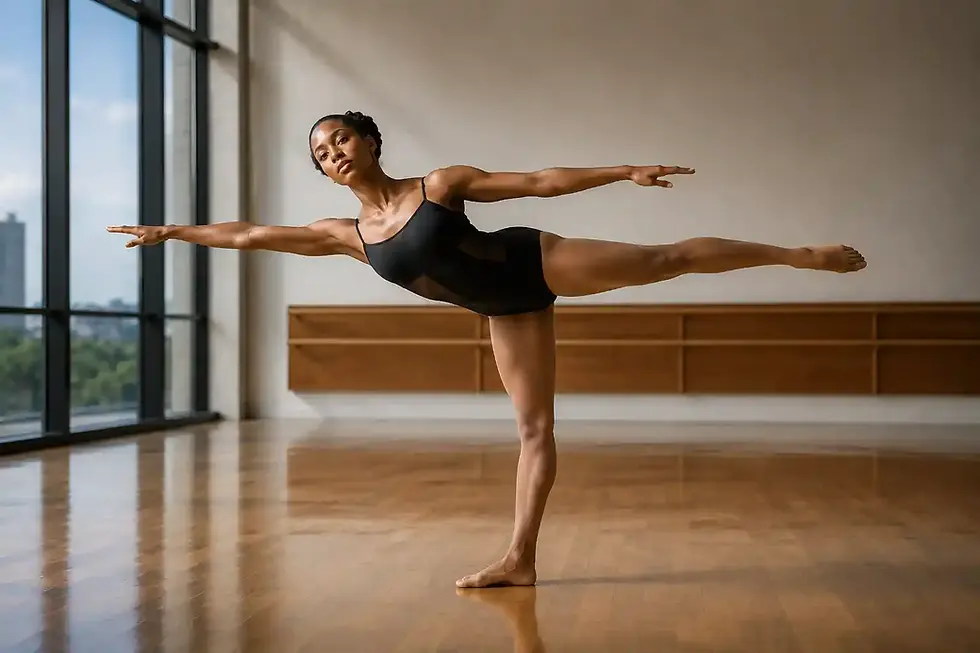
What Is a Lateral T in Horton Technique Modern Dance?
The Lateral T is a side-bending position where the torso extends horizontally over one leg while maintaining a long, straight spine. Both arms remain fully extended to create the shape of the letter "T."
Unlike a relaxed side bend, the Horton Lateral T requires:
Length through both sides of the torso
Strong engagement of the core
Stable hips and legs
Active reach through the fingertips
Continuous energy from head to toe
Every part of the body remains energized throughout the movement.
Why Learning Lateral T's in Horton Technique Modern Dance Is Important
The Lateral T teaches dancers how to move laterally without collapsing the spine. This movement develops technical skills that transfer directly into choreography and advanced contemporary dance combinations.
Benefits include:
Improves spinal flexibility
Builds core stability
Develops shoulder strength
Enhances balance and coordination
Increases body awareness
Promotes clean movement lines
Strengthens supporting leg muscles
Improves posture and alignment
These qualities help dancers perform with greater confidence and efficiency.
Proper Technique for a Horton Lateral T
To execute the movement correctly:
1. Begin with Proper Alignment
Stand tall with the feet grounded and the core engaged.
2. Extend the Arms
Reach both arms fully outward at shoulder height, creating a long horizontal line.
3. Lengthen Before Bending
Instead of collapsing sideways, imagine growing taller before reaching across the room.
4. Maintain a Straight Spine
The torso should remain long rather than rounded.
5. Keep the Hips Stable
Avoid shifting or twisting the pelvis during the movement.
6. Return with Control
Use the abdominal muscles to lift back to the starting position without relying on momentum.
Common Mistakes When Learning Lateral T's in Horton Technique Modern Dance
Many beginners experience similar challenges.
Avoid these mistakes:
Dropping the supporting shoulder
Rounding the back
Collapsing into the waist
Locking the knees
Losing core engagement
Uneven arm placement
Twisting the torso
Moving too quickly
Focusing on quality rather than speed will produce better long-term results.
Exercises That Help Improve Your Lateral T
Several conditioning exercises support better execution.
Side Stretch Series
Improves flexibility through the ribs and torso.
Core Stability Exercises
Planks and side planks help maintain control during lateral movement.
Hamstring Stretching
Flexible hamstrings make maintaining alignment much easier.
Shoulder Mobility Drills
Improves arm positioning and upper body endurance.
Balance Exercises
Single-leg stability strengthens the supporting leg and enhances body control.
How Lateral T's Improve Contemporary Dance Performance
Because Horton Technique emphasizes total-body integration, the Lateral T develops movement skills that appear throughout contemporary choreography.
Dancers often notice improvements in:
Floor work
Turns
Traveling combinations
Extensions
Partnering
Direction changes
Dynamic movement quality
These improvements make dancers more versatile across many dance styles.
Tips for Beginners
If you're just starting your Horton Technique training:
Practice in front of a mirror.
Focus on length instead of depth.
Engage your abdominal muscles continuously.
Breathe naturally throughout the movement.
Move slowly before increasing speed.
Practice consistently for steady improvement.
Small technical improvements build a stronger dance foundation over time.
Final Thoughts
Learning Lateral T's in Horton Technique Modern Dance is an essential step toward developing strength, flexibility, precision, and expressive movement. Although the position appears simple, it demands full-body coordination and disciplined technique.
With consistent practice and proper instruction, the Lateral T becomes a valuable tool that enhances contemporary dance performance while preparing dancers for more advanced Horton Technique vocabulary.
Helpful Resources
Contemporary Dance Classes at Inez Patricia School of Dance
Alvin Ailey American Dance Theater – Horton Technique
Encyclopaedia Britannica – Modern Dance


Comments